
C++ · Python · CMS Open Data
ResolvedEnergyCorrelators
A computational speed-up that broke records for N-particle energy correlations, turning physics-rich QCD correlations into "bullseye" images you can read intuitively.
Developing tools and always seeking more applications and understanding. I build theoretical and computational frameworks for modelling and visualizing complex phenomena, using techniques spanning quantum field theory, Monte-Carlo methods, and machine learning.
A few projects I'm most proud of. Each one takes an abstract idea in quantum chromodynamics and turns it into open, reproducible software that produces real, interpretable pictures.
A computational speed-up that broke records for N-particle energy correlations, turning physics-rich QCD correlations into "bullseye" images you can read intuitively.
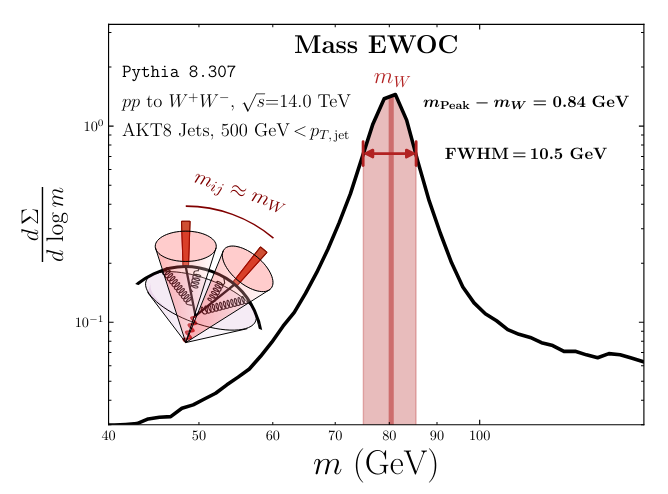
A toolset for computing energy-weighted differential cross sections between pairs of jet and subjet observables — correlations I playfully call EWOCs. Energy weighting lets us take the physics we understand "more seriously" than the physics we don't, isolating clean, calculable structure inside messy hadronic events at the LHC.
Python Monte-Carlo tools for jet physics — phase-space integration and parton-shower algorithms accurate to leading and modified-leading-logarithmic order. This is the engine behind PIRANHA, a continuous jet-grooming paradigm I introduced that smoothly removes contamination from jets instead of making hard, discrete cuts.
I recently finished my Ph.D. in theoretical physics at MIT, where I worked with Jesse Thaler in the Center for Theoretical Physics on the unifying question of my Ph.D. research: how does energy flow when you break apart the smallest known pieces of the universe?
My thesis, Particles Inside Particles, built the analytic and probabilistic foundations of energy-correlator observables, derived the mathematics behind parton-shower simulations, and turned those ideas into open-source software tested against real collider data. Along the way I've published in Physical Review Letters and JHEP, and contributed to work on superconducting-qubit noise and searches for physics beyond the Standard Model.
The common thread — probability, statistical inference, information theory, and computation at scale — is what pulls me toward scientific programming and machine learning, where the same toolkit finds new problems to solve. I also spent five years as a teaching assistant at MIT (earning perfect evaluations in String Theory) and love making hard ideas feel obvious.
Outside of work you'll usually find me traveling, climbing, reading, or losing gracefully at chess.
Research isn't the whole story here — but it's where a lot of the ideas were sharpened. The full list, including my thesis and talks, lives on the publications page.
I'm always happy to talk about physics, code, or interesting problems — whether it's research, a role, or a collaboration. The fastest way to reach me is email.